The Valley of Bones

[A quick note to say that I’ve recently been writing posts for the geology/education blog The Earth Story and I’m going to start cross-posting some of those pieces here, in expanded form. TES can be found on Facebook at facebook.com/theearthstory, on Tumblr at the-earth-story.com, and Twitter as @TheEarthStory. The original for the following post can be found at: https://www.facebook.com/TheEarthStory/posts/967000540027657:0]

100_2960

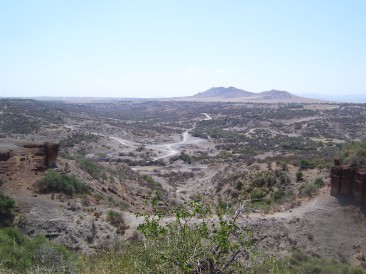
West of the volcanic slopes of Ngorongoro Crater, which was covered in another post not long ago, there is a deep cut across the landscape that interrupts the wide Serengeti Plains in northern Tanzania. A dry, winding ravine exposes layers of lava and ash, and within them, the traces of early human evolution. Named for a European misunderstanding of the Maasai word for wild sisal flowers, oldupai, Olduvai Gorge has a rich history of paleoanthropological finds, grueling excavations, and intriguing characters. Continue reading

Field Notes: Ethiopia 2.0

20151101_082115

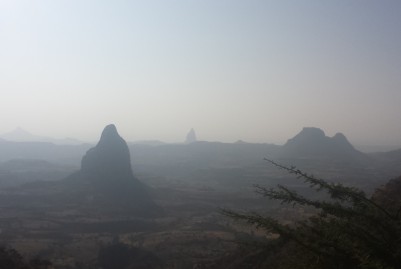
Rough-backed mountains with strange straight-sided peaks and pinnacles of rock recede into the misty distance, and the umbilical thread of what will be the world’s longest river spills out of a round-bellied lake. Nestled invisibly within the landscape are castles, monasteries with secret treasures, and Christian churches cut from ancient stone, though the most prominent Highland scenes usually involve sheep and cows ranging over the rocky slopes. These are the Ethiopian Highlands, not the Scottish, however, and in November blue skies and balmy temperatures reign. Continue reading

Goodnight Moon, Good Morning Mars

It has been a week for the heavens since the supermoon eclipse, with news from Mars and all the way from Hollywood, and with all the advances in the past year, space begins to seem not less vast but more knowable.

DSCN2025

I watched the eclipse from the fields across the street from my house, wrapped in a blanket and a thermos of mint tea. At first the full moon didn’t seem much larger than normal, but so very bright I could write by it. It was an almost perfect night for watching the sky, with only a few high clouds. It’s been a long time since I’ve done any real stargazing, though I know the summer constellations pretty well, and sometimes I’ll go out and look a bit on clear nights. But my telescope at home is sadly neglected. I wasn’t the only one taking advantage of the dark sports field; there were neighborhood families with kids running around, turning cartwheels on the grass and yelling. I was gritting my teeth a little at the noise – I do a good impression of an 83 year old curmudgeon sometimes – but besides the fact that it wasn’t my lawn to tell people to get off of, if there’s one thing kids should be loud and curious and excited about, it’s the, you know, SUPER COOL SPACE THING happening in the sky.

DSCN2040

Because my nephew, the first of the next generation, was born this summer, there has been a strong resurgence in childhood favorites lately, especially books and music. In putting together picture book care packages and lullaby playlists, I noticed a common theme in many of our old standbys: Goodnight Moon, Owl Moon, I see the moon and the moon sees me… I remember my parents taking us out to the backyard to watch the Leonid meteor shower as a kid, and I wrote one of my first real poems about it. I think I’d always been more interested in the poetry and stories in the stars than the mechanics of space, perhaps because as a geologist, I wouldn’t want to study something I couldn’t get my hands dirty on.

DSCN2043

The same weekend that I visited my nephew for the first time, I stole my brother-in-law’s copy of The Martian when he had finished it, and read the whole thing in time to have it back to him before we got on the plane home (There was a lot of downtime during naps for baby and parents alike). It was a thrilling read, and note-perfect in its depiction of engineers and scientists; the characters out of NASA acted and talked like half the people I know. What was most striking about The Martian, though, was that it got me engaged in a space exploration story for the first time in a long while, by telling a space story that was, strangely enough, grounded. It felt immediate and hands on and very real, with duct-tape solutions and faulty wiring and EXTREME BOTANY.

DSCN2069

And then! To have to announcement of water on Mars the day after the eclipse and the week of the movie release for The Martian makes for space on the brain. The Mars Reconnaissance Orbiter detected hydrated minerals in the same location as “recurring slope linae” – dark streaks that appear to flow downhill and ebb and flow with the different seasons. Coupled with other recent advances like Curiosity, the Philae comet lander, and New Horizons (which just released new high-res photos of Pluto’s moon Charon as well as more of Pluto itself), there is a definite sense of rekindled excitement for space exploration. Water on the red planet and red shadows on the moon: eclipses are always dramatic events, but liquid water on another world is a monumental discovery, another step towards stories we’ve only imagined of distant planets and alien life.

DSCN2111 (2)

At the Edge of the Black Lagoon

DSCN1851 (2)

Earlier this summer, I visited the trails at Sapsucker Woods, a place of ponds filled with lilies and singing bull frogs, and boardwalks over fern-filled swamps where the mirror-smooth water resulted in a vision of a sepia-toned underworld just beneath your feet. The watery landscape was entrancing in a way that is very different from walking the hills or the lakeshore, and I found myself thinking about the singular ways that wetlands resonate in human consciousness. There is a special in-between quality to wetlands, a porous boundary with no clear shore that lingers in the imagination. Marshes and swamps and fens, like mountainsides and moors, are wildernesses that belong to monsters and outcasts, or to the dead. In Beowulf, Grendel and his mother haunt the “awful fenpaths, where the upland torrents plunge downward under the dark crags, the flood underground.” From Old English to a modern day example, there’s Tolkien, an eternal Beowulf fanboy, and his Dead Marshes with their drowned warriors.

DSCN1847

Often these depictions are meant as a warning – to fear the creature in the black lagoon. Avoid the Great Grimpen Mire, and don’t follow the will-o’-the’whisp, the light that pixies and púcas use to lead travelers off the path to drown. Just from Saturday morning cartoons alone, we probably all thought quicksand was going to be a bigger deal in life than it ended up being. No matter what the setting, human beings tend to create stories about their physical landscapes. The special place of dread and possibility that wetlands hold in the imagination, though, doesn’t disappear with scrutiny. The archaeological stories held within wetlands are as intriguing as any myth. Maybe more so, because they are often sparse on all but the most gruesome of details.

Continue reading

#littlefieldworkthings

Forgetting you tucked your pants in your socks to avoid ticks and walking into CVS like that.

Visiting Lowes 4 days running, making a total of 5 trips for a week long service run.

Playing a game called “Sunburn, Dirt, or Bruise?” at the end of the day.

Pickup truck rides! My favorite people are the ones with big fields with seismometers at the bottom who give me rides in their trucks/golf carts/Arctic Cats. My least favorite people are the ones with big fields with seismometers at the bottom who don’t give me rides. On the other hand, my step count on my phone is quite high this week.

Stopping on the highway for 10 minutes because a Very Large Farm Vehicle (combine? crop sprayer? It was two stories tall and took up two lanes) had parked in the center of the road and seemed unwilling to move.

A church sign that said “Your name may be on a bottle of Coke, but is it in the Book of Life?”

A laundromat sign that said “Suds Yer Duds”

Too many “Jesus/Christ is Lord/The Answer” signs to count, but in spatial terms probably not as many as the Elmira/Southern Tier area has in terms of religious imagery per mile. If I am ever here in winter, I will have to compare numbers of monumental glowing Christmas emblems blazoned on the countryside. Oklahoma may be at a disadvantage as there are no proper hills for a two-story Christmas wreath to hang on like we have. Maybe they can decorate one of the Very Large Farm Vehicles or a wind turbine.

Sharing the roads and fields with rabbits, deer, pheasants, and hordes of large yellow grasshoppers which leap from the grass ahead of you like a wave before a ship as you walk through a field – A+, would nature-gaze again. Sharing the field with an early morning skunk heading your direction – Do not want.

AN ACTUAL ROADRUNNER JUMPED OUT THE BUSHES AND RAN ALONG IN FRONT OF MY CAR. TURNS OUT THEY RUN ABOUT 15 MPH.

TOO HOT. (hot damn)
TOO HOT.
(hot damn)

Drawing Bones and Mapping Worlds

Title aside, this post has nothing to do with the summers I spent designing tombstones; instead, it’s about how 2 of my favorite things come together: drawing and science. I don’t think it surprises anyone to say that art and science can go hand in hand; scientific illustration and imagery is often the easiest way for the public to engage with new research – think how exciting new images from Hubble are, or pictures from the latest deep sea dive of new species that look like they came from the Black Lagoon. The field of scientific illustration allows access to concepts otherwise unobservable, from microscopic to macroscopic. Physical and natural sciences like botany, biology, etc all rely on a long tradition of illustrators providing precise diagrams and figures, which communicate in a more universal language than any text. In the case of geology and archaeology, something that has always delighted me is how vital bringing together artistic skills with field research could be, from sketching artifacts and mapping outcrops, even to planning geophysical surveys.

002

finback
Finback whale

Continue reading