Posts
Field Notes: The Hats of Yellowstone

A spate of reports on irresponsible meddling and mishaps in Yellowstone National Park this spring set the stage for my visit there last month. It’s easy to laugh when tourists face the consequences of their determination to get the perfect bison, bear or moose selfie. Less entertaining was the group who, having spotted a lone bison calf, decided that it looked cold and put it into the back of their SUV. The calf later had to be euthanized when its herd refused to accept it back. All this had me braced to witness misbehavior in the park, with humans proving a danger to themselves and the wild park inhabitants. Just prior to my visit, though, two more incidents highlighted the dangers of the park itself: in the hydrothermal areas, where geysers and hotsprings bubble up through the ground, a man and his son slipped and were burned, and in a separate incident, another man fell into a thermal pool and died.
My trip took place after the end of a department field trip to Wyoming, and as we got ready to split from the group to head to Yellowstone, everyone, from professors to grocery store cashiers to hotel clerks, repeated the headlines back to us and warned us to be careful, to not leave the trails. At the park, signs everywhere warned the same things: Do not leave the boardwalk. Bear selfies? Not ever. Do not approach within 100 yards of bears or wolves, 25 yards for other animals. Less than a week after a fatal accident, you might think these cautions would be in the front of everyone’s minds, but we still saw people stepping off the boardwalks onto steaming ground, posing for the perfect snapshot. Continue reading
Irish MPs Urge Obama to Revoke Wounded Knee Medals


23 members of the Irish Parliament sent a recent letter to President Barack Obama urging him to revoke the 20 Medal of Honor awards given to the soldiers who perpetrated the Massacre at Wounded Knee in 1890. They argue that the medals are a standing insult to the Lakota, and all Native Americans.
The Lakota People’s Law Project steadfastly sides with the members of the Irish parliament in recognizing these honors not only represent a stain on United States history but taint the very prestige of the Medal of Honor itself.
How did the Irish become involved in matters specific to Native Americans? The little-known shared history between the two sovereign nations holds several examples of fraternity and mutual understanding.
During the Irish potato famine of 1845-49, when thousands of Irish were starving as potato crops failed, the Emerald Isle received an unexpected gift from a group of sympathetic people…
View original post 458 more words
The Rift’s the Thing

From the western lip of Almannagja Fissure, the view spans continents: the fissure is the western boundary of a graben (a depressed block of rock bordered by two parallel faults) that marks the Mid-Atlantic Ridge cutting through Iceland. The 8 km long fissure is one of the rift features that makes Thingvellir National Park such a dramatic setting, caught between the North American and Eurasian plates. The tectonic plates pulling apart formed the landscape into lava fields and rift scarps, with tall cliffs and shallow rift lakes forming a backdrop to a cultural landscape that is equally impressive. Thingvellir National Park was the site of the Althing, the Icelandic national assembly, from 930 to 1798 C.E. For the Norse, a “thing” was a governing assembly of the free members of society, where laws were set and disputes were settled. Fragments of the stone and turf booths where attendees of the Althing met in the open air are still visible in the park; it was declared a UNESCO World Heritage Site in 2004 for its significance to Icelandic culture and history.
Sources: http://bit.ly/1SD0R4F
http://bit.ly/23SyTdM
Image credit: Ragnar Sigurdsson (arctic-images.com) (distributed via imaggeo.egu.eu)
Reposted from: https://www.facebook.com/TheEarthStory/posts/1054082034652840:0
From Saga to Science: American Vikings
Recent news of Norse remains in North America has rekindled my interest in what was once the main theme of this blog, the connections between literature, myth, and archaeology. Much of Viking archaeology has been spurred by scholarship of medieval literature; some of the most notable archaeological discoveries of the past two centuries have been those guided by details from the classical and medieval epics. The impulse to look for archaeological roots to literary sources like the Icelandic Sagas, with their accounts of Viking adventures spanning Norway, Iceland, Greenland, and America, illustrates the power that stories have over even the most academic of imaginations, causing researchers to embark on long quests for sites like the lost Viking Vinland.

The Icelandic Sagas are prose histories written in the 13th and 14th centuries describing events that took place in the 10th and 11th. While most of the sagas focus on folk stories or family histories, some depict the Viking expansion westward: the settlement of Iceland, Greenland and the western land known as “Vinland.” Stripped of their supernatural trimmings of ghosts and seers, the Saga of the Greenlanders and the Saga of Eirik the Red tell similar stories of the arrival of Icelanders on the northeast coast of America, at first the accidental result of the harsh storms of the northern Atlantic, but later a deliberate attempt at colonization, four centuries prior to Columbus.
Rescue Operations: the Libraries of Timbuktu
When rebels and militants took over Timbuktu in 2012, the world nearly saw a repeat of the tragedy of the Library of Alexandria: hundreds of thousands of priceless medieval manuscripts were in peril in the occupied city. Under the eye of militants intent on destroying the centuries of Sufi scholarship contained in Timbuktu’s libraries, mausoleums, and mosques, a courageous group of Malinese set out to protect the books.

Ondatra zibethicus

Between our beach and the one attached to the cottage next door is a shrubby bank that slides steeply down to the water, where fallen logs, overhanging branches, and trapped driftwood create a small warren for another, mostly unseen neighbor. Occasionally I’ve spotted a small dark head plowing through the water, and the glean of a wet back, or a quick splash as the muskrat slips off a log into the lake. Fortunately, this Rat doesn’t seem to like messing about in boats; our sailboat is pulled ashore just next to this little wooded area, and it would be an interesting experience to find a stowaway half-way out into the lake.

This fall, while I walking on the beach (with a dauntless dog that quite enjoyed the cold water), I found something besides seaglass or shells – a matched set of jawbone halves washed up on the shore. They were washed clean, and clearly rodent, with large pointed front teeth and the flat molars of an herbivore. The large separation between the front incisors and the cheek teeth is called a “diastema;” the remaining incisor has the characteristic orange tint of rodents. Given the size of the bones and the location, they are likely from a muskrat; a squirrel or rat would be smaller, a beaver larger. I hope it isn’t our neighbor; I’ll be keeping a look out in the spring. In the meantime, Ondatra makes for excellent sketchbook fodder.


Field Notes: Ethiopia 2.0
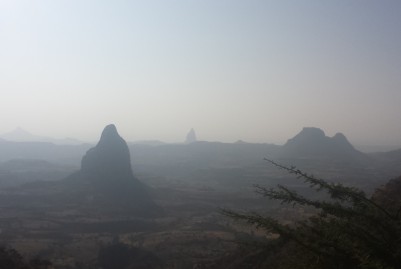
Rough-backed mountains with strange straight-sided peaks and pinnacles of rock recede into the misty distance, and the umbilical thread of what will be the world’s longest river spills out of a round-bellied lake. Nestled invisibly within the landscape are castles, monasteries with secret treasures, and Christian churches cut from ancient stone, though the most prominent Highland scenes usually involve sheep and cows ranging over the rocky slopes. These are the Ethiopian Highlands, not the Scottish, however, and in November blue skies and balmy temperatures reign. Continue reading
Goodnight Moon, Good Morning Mars
It has been a week for the heavens since the supermoon eclipse, with news from Mars and all the way from Hollywood, and with all the advances in the past year, space begins to seem not less vast but more knowable.

I watched the eclipse from the fields across the street from my house, wrapped in a blanket and a thermos of mint tea. At first the full moon didn’t seem much larger than normal, but so very bright I could write by it. It was an almost perfect night for watching the sky, with only a few high clouds. It’s been a long time since I’ve done any real stargazing, though I know the summer constellations pretty well, and sometimes I’ll go out and look a bit on clear nights. But my telescope at home is sadly neglected. I wasn’t the only one taking advantage of the dark sports field; there were neighborhood families with kids running around, turning cartwheels on the grass and yelling. I was gritting my teeth a little at the noise – I do a good impression of an 83 year old curmudgeon sometimes – but besides the fact that it wasn’t my lawn to tell people to get off of, if there’s one thing kids should be loud and curious and excited about, it’s the, you know, SUPER COOL SPACE THING happening in the sky.

Because my nephew, the first of the next generation, was born this summer, there has been a strong resurgence in childhood favorites lately, especially books and music. In putting together picture book care packages and lullaby playlists, I noticed a common theme in many of our old standbys: Goodnight Moon, Owl Moon, I see the moon and the moon sees me… I remember my parents taking us out to the backyard to watch the Leonid meteor shower as a kid, and I wrote one of my first real poems about it. I think I’d always been more interested in the poetry and stories in the stars than the mechanics of space, perhaps because as a geologist, I wouldn’t want to study something I couldn’t get my hands dirty on.

The same weekend that I visited my nephew for the first time, I stole my brother-in-law’s copy of The Martian when he had finished it, and read the whole thing in time to have it back to him before we got on the plane home (There was a lot of downtime during naps for baby and parents alike). It was a thrilling read, and note-perfect in its depiction of engineers and scientists; the characters out of NASA acted and talked like half the people I know. What was most striking about The Martian, though, was that it got me engaged in a space exploration story for the first time in a long while, by telling a space story that was, strangely enough, grounded. It felt immediate and hands on and very real, with duct-tape solutions and faulty wiring and EXTREME BOTANY.

And then! To have to announcement of water on Mars the day after the eclipse and the week of the movie release for The Martian makes for space on the brain. The Mars Reconnaissance Orbiter detected hydrated minerals in the same location as “recurring slope linae” – dark streaks that appear to flow downhill and ebb and flow with the different seasons. Coupled with other recent advances like Curiosity, the Philae comet lander, and New Horizons (which just released new high-res photos of Pluto’s moon Charon as well as more of Pluto itself), there is a definite sense of rekindled excitement for space exploration. Water on the red planet and red shadows on the moon: eclipses are always dramatic events, but liquid water on another world is a monumental discovery, another step towards stories we’ve only imagined of distant planets and alien life.

At the Edge of the Black Lagoon

Earlier this summer, I visited the trails at Sapsucker Woods, a place of ponds filled with lilies and singing bull frogs, and boardwalks over fern-filled swamps where the mirror-smooth water resulted in a vision of a sepia-toned underworld just beneath your feet. The watery landscape was entrancing in a way that is very different from walking the hills or the lakeshore, and I found myself thinking about the singular ways that wetlands resonate in human consciousness. There is a special in-between quality to wetlands, a porous boundary with no clear shore that lingers in the imagination. Marshes and swamps and fens, like mountainsides and moors, are wildernesses that belong to monsters and outcasts, or to the dead. In Beowulf, Grendel and his mother haunt the “awful fenpaths, where the upland torrents plunge downward under the dark crags, the flood underground.” From Old English to a modern day example, there’s Tolkien, an eternal Beowulf fanboy, and his Dead Marshes with their drowned warriors.

Often these depictions are meant as a warning – to fear the creature in the black lagoon. Avoid the Great Grimpen Mire, and don’t follow the will-o’-the’whisp, the light that pixies and púcas use to lead travelers off the path to drown. Just from Saturday morning cartoons alone, we probably all thought quicksand was going to be a bigger deal in life than it ended up being. No matter what the setting, human beings tend to create stories about their physical landscapes. The special place of dread and possibility that wetlands hold in the imagination, though, doesn’t disappear with scrutiny. The archaeological stories held within wetlands are as intriguing as any myth. Maybe more so, because they are often sparse on all but the most gruesome of details.
 quakeandquiver.com