Forgetting you tucked your pants in your socks to avoid ticks and walking into CVS like that.
Visiting Lowes 4 days running, making a total of 5 trips for a week long service run.
Playing a game called “Sunburn, Dirt, or Bruise?” at the end of the day.
Pickup truck rides! My favorite people are the ones with big fields with seismometers at the bottom who give me rides in their trucks/golf carts/Arctic Cats. My least favorite people are the ones with big fields with seismometers at the bottom who don’t give me rides. On the other hand, my step count on my phone is quite high this week.
Stopping on the highway for 10 minutes because a Very Large Farm Vehicle (combine? crop sprayer? It was two stories tall and took up two lanes) had parked in the center of the road and seemed unwilling to move.
A church sign that said “Your name may be on a bottle of Coke, but is it in the Book of Life?”
A laundromat sign that said “Suds Yer Duds”
Too many “Jesus/Christ is Lord/The Answer” signs to count, but in spatial terms probably not as many as the Elmira/Southern Tier area has in terms of religious imagery per mile. If I am ever here in winter, I will have to compare numbers of monumental glowing Christmas emblems blazoned on the countryside. Oklahoma may be at a disadvantage as there are no proper hills for a two-story Christmas wreath to hang on like we have. Maybe they can decorate one of the Very Large Farm Vehicles or a wind turbine.
Sharing the roads and fields with rabbits, deer, pheasants, and hordes of large yellow grasshoppers which leap from the grass ahead of you like a wave before a ship as you walk through a field – A+, would nature-gaze again. Sharing the field with an early morning skunk heading your direction – Do not want.
AN ACTUAL ROADRUNNER JUMPED OUT THE BUSHES AND RAN ALONG IN FRONT OF MY CAR. TURNS OUT THEY RUN ABOUT 15 MPH.
Title aside, this post has nothing to do with the summers I spent designing tombstones; instead, it’s about how 2 of my favorite things come together: drawing and science. I don’t think it surprises anyone to say that art and science can go hand in hand; scientific illustration and imagery is often the easiest way for the public to engage with new research – think how exciting new images from Hubble are, or pictures from the latest deep sea dive of new species that look like they came from the Black Lagoon. The field of scientific illustration allows access to concepts otherwise unobservable, from microscopic to macroscopic. Physical and natural sciences like botany, biology, etc all rely on a long tradition of illustrators providing precise diagrams and figures, which communicate in a more universal language than any text. In the case of geology and archaeology, something that has always delighted me is how vital bringing together artistic skills with field research could be, from sketching artifacts and mapping outcrops, even to planning geophysical surveys.
A M7.5 earthquake in Papua New Guinea, recorded at Cornell.
Another large earthquake happened this week in Papua New Guinea; though a tsunami warning was issued, damage was and no serious injuries occurred. Compared to the 7.8 Nepal earthquake, the impact was minuscule – mainly because this quake was much deeper.
There is a particular feeling of helplessness that comes with being a seismologist when a disaster like the Nepal earthquake happens. I spend most of my day thinking about earthquakes in some capacity; I get a couple of alerts a day from the USGS about M3s and 4s in Oklahoma and think, ooh, data, or a M6 hundreds of kilometers deep where it will never be felt, but waking up to a 7.8 last Saturday provoked a moment of both clarity and confusion – that this one was going to mean something real and something terrible. Continue reading →
Oklahoma might not seem like a first choice for a spring break getaway, but sun, warmth, and the outdoors make for a good spring break, even if you have to spend it working. If you’re a seismologist in upstate NY you have to follow where the earthquakes go. I’m thinking of saving up for a tricked out pickup and painting “Earthquake Chasers” on the side, like the tornado hunters we kept running into at gas stations, somewhat unnervingly.
Out standing in my field
If you’re hearing earthquakes and Oklahoma in the same sentence and getting confused, welcome to the strange new future where OK was the most earthquake-prone state in 2014, more than California. Since 2009 the number of quakes has gone from 1 or 2 felt events a year to 1 or 2 a day; in an animation from the USGS, you can see earthquakes blossom across the entire central portion of the state: http://earthquake.usgs.gov/earthquakes/states/oklahoma/OKeqanimation.phpContinue reading →
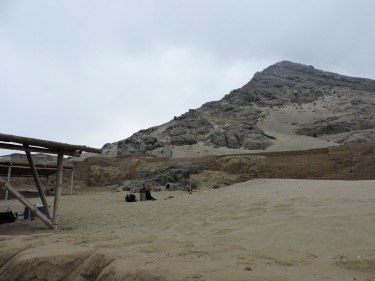
In the middle of a sand-filled plaza surrounded by decaying walls, a coarse jumble of black boulders spills out of the ground like it was just disgorged by the volcanic peak above. A crowd gathers at the edges, peering at the strangely garbed figures processing with agonizing slowness across the sacrificial platform. An ominous sound fills the air.
Beep.
Beep.
Beep.
Other than sweat and possibly tears or blood, there are no sacrifices today, just scientists in robotic get ups working to figure out what lies beneath the surface at Huaca de la Luna, the Temple of the Moon. You’ll have to forgive the title that sounds like a lost Tintin book; this is where I spent two weeks of my summer this year, listening to the near constant “beep” of ground penetrating radar pulses, hauling equipment, and in between, exploring one of the most impressive archaeological sites in the Americas.
This week was the five year anniversary of the earthquake which left Port au Prince and much of Haiti devastated. It was a magnitude 7 event, caused by a strike-slip fault rupturing 8 miles beneath the surface and releasing waves of seismic energy – we talk about it now and then in some of my classes. Describing the technical aspects from a seismology viewpoint doesn’t much get at the heart of what happened after that, though. Estimates of the casualties range from 160,000 to 300,000 killed, with one third of Haiti’s population of 9 million directly affected, and $8 billion in damages. Recovery over the last few years has been slow, with one physician working in Haiti diagnosing the problems caused by the earthquake as “acute-on-chronic.” The severity of the damage – physically, socially, and economically – was greatly exacerbated by already existing chronic problems in the country.
We measure earthquakes in beachballs.
“Acute-on-chronic”: one of the acute symptoms would be the number of buildings that collapsed due to the quake – some 250,000 homes. The amount of destruction is an expression of the chronic problems of rapid urbanization, unsafe construction, and lack of building codes meant to resist seismic hazard. The issue can be traced further; high rates of urbanization followed the collapse of the agricultural industry in Haiti after American subsidies of US rice farms flooded the market with cheap rice – something that Bill Clinton apologized publicly for in the months after the quake. Tetanus cases from injuries in the quake were widespread largely because of failure to vaccinate. The health system was overwhelmed by the disaster, then by the cholera epidemic which followed. Haiti hadn’t had a case of cholera in over a hundred years; it was spread from foreign aid workers.
Haiti leads the Western Hemisphere in ratings of poverty, health, and water security, and any attempt to address those problems needs to look at the history that contributed to them, from the coups and turmoil of the 1980s and 1990s to the exorbitant reparations required by France after Haiti’s revolution cost the French much of their slave trade. In the aftermath of the earthquake, donations and aid poured in, but this week op-eds have abounded on where that money has gone and why more progress hasn’t been made. Of $1.5 billion from USAID, only 1 cent out of every dollar went directly to Haitian organizations; money instead went to international contractors who cost 5 times more than local workers. Providing funds directly to Haitian organizations or government agencies is apparently a sticking point for foreign donors, who have resisted contributing to a UN proposed trust fund that would be controlled by the Ministries of Health and Environment. Complicated problems can require clever ways to address them – I remember reading about aid workers in the immediate aftermath using Google Earth to track what areas needed help because the blue UN tents were visible in satellite imagery. But it seems that having people on the ground who know what they need and what will work, instead of foreign contractors, is a key point. The Health Ministry is one of the few that does receive direct funding, and has apparently made large amounts of progress in HIV treatments and child vaccinations.
If you have a moment or the means to donate, some of the groups doing the best work in Haiti are Partners in Health and Zanmi Lasante, the local Haitian extension of PIH; they run 12 hospitals and clinics in Haiti, and were some of the first medical professionals on the scene after the earthquake. ZL is the largest nongovernment health care provider in Haiti, with a staff of 5,400 Haitians serving 1.3 million. Currently, there is a quiz on the PIH site about maternal health; for everyone who takes the quiz, 50 cents will be donated: http://act.pih.org/page/s/quiz?source=tout&subsource=tout_country
I also recommend water.org; they help provide clean water and sanitation proposals, working with local organizations from proposals put forth by the communities themselves: http://water.org/country/haiti/
Like wildebeest through the Serengeti, the common Homo geologicus make their way through San Francisco International Airport in droves, identifiable by ever-present poster tubes, hiking boots, and a tendency to flannel. It is once again that time of year, for the long migration known as the fall meeting of the American Geophysical Union.
Or rather, it was that time of year, since the conference was before Christmas. About 25,000 geoscientists come to this every year, including myself this year; I was presenting a poster on my undergrad research in Tanzania. The posters and talks available are innumerable, so the first challenge is figuring out what to go to first, but the main themes I followed this year were energy, climate, and induced earthquakes related to energy projects.
Excellent post on the risks fracking poses to developing nations; in NY we’re used to thinking of this as a local issue because of its prominence here, but it is a much wider problem.
I’d like to give a warm shout out to all my friends soldiering through in Buffalo with your literally above my head levels of snow – at this point you should probably consider giving in and hibernating through the rest of the year. No one will judge. Even for upstate and our beloved lake effect, this week’s storm was intense for this time of year, though sadly Ithaca remains almost entirely snow free. The weather was quite apropos considering the activities this week at Cornell, which was a busy one so far as climate change and its effects were concerned. The president of Iceland was visiting, and hopefully felt right at home. The weekly department seminar was as relevant a topic as you could hope to have for a presentation: “Has a warming Arctic contributed to colder winter weather in the Northern Hemisphere mid-latitudes?”




 quakeandquiver.com