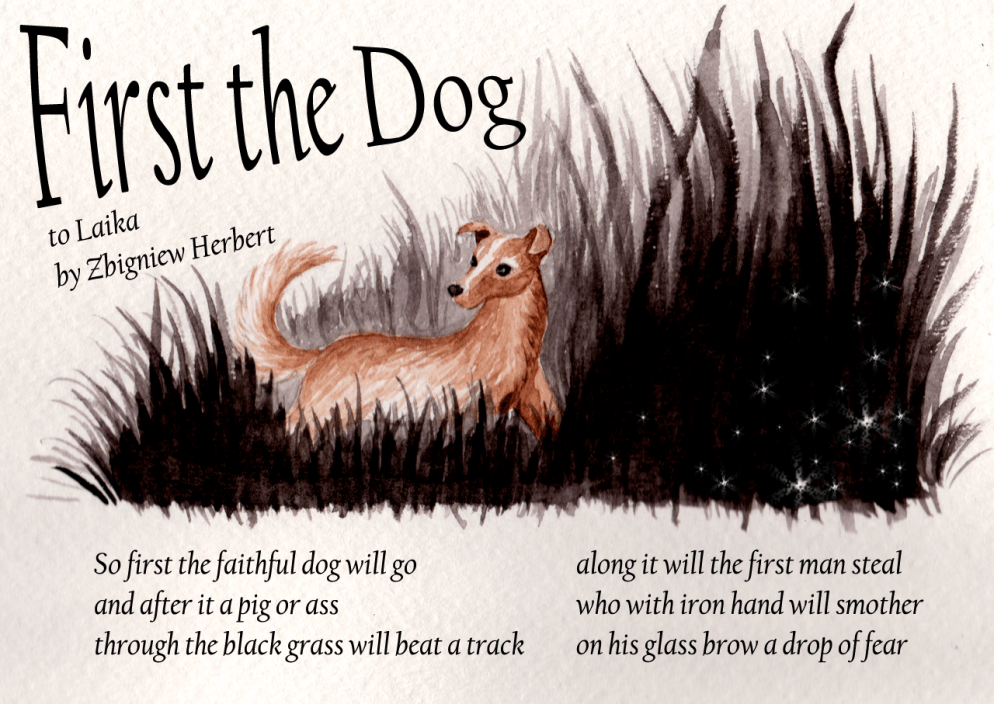
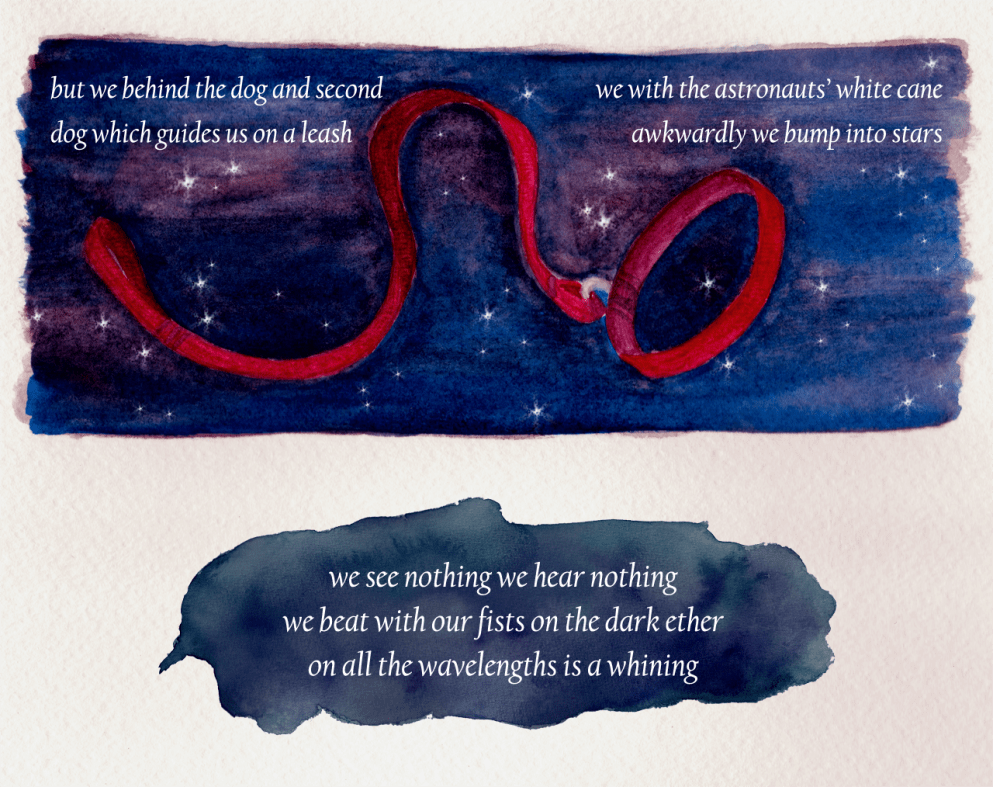
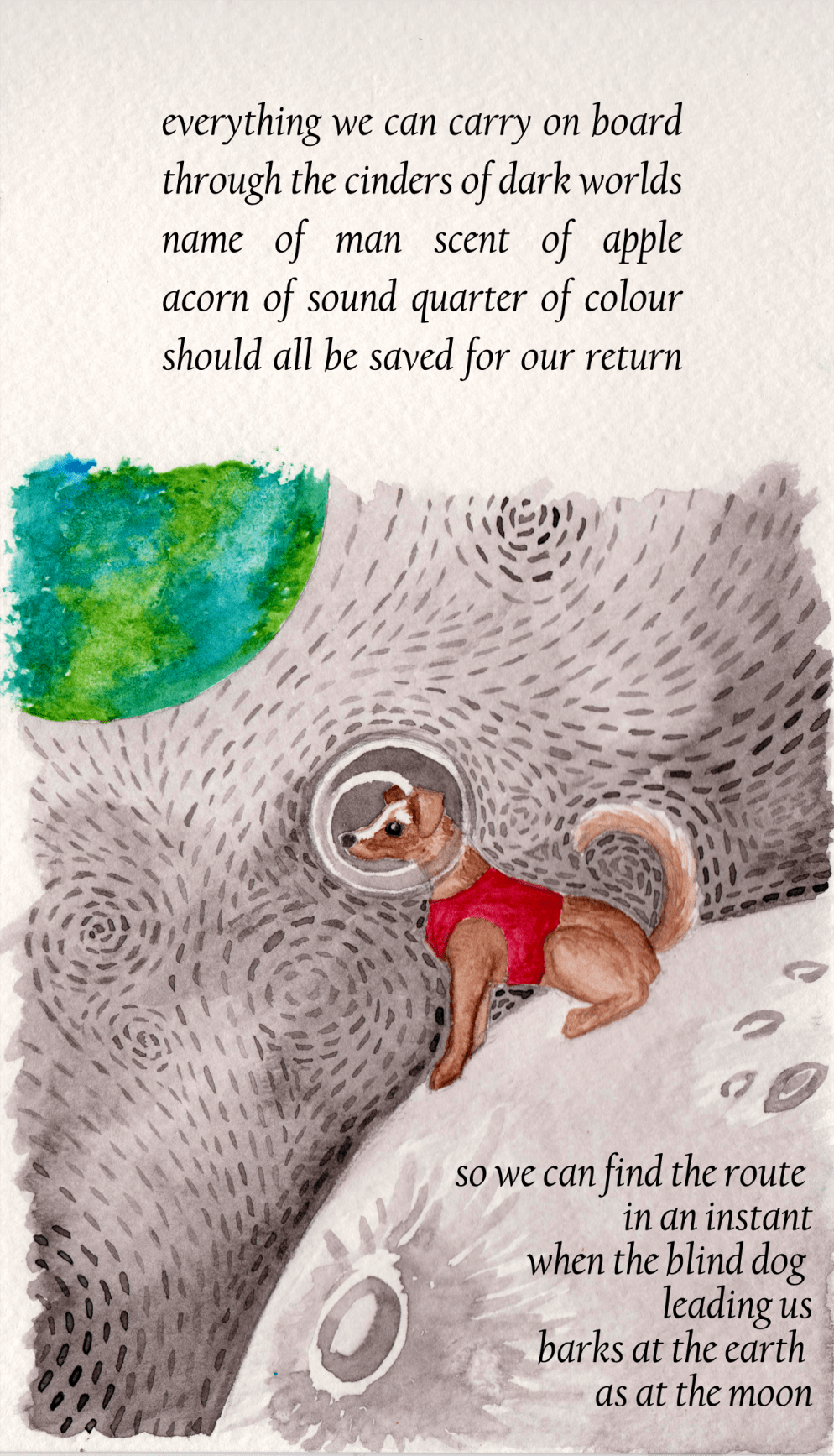
First the Dog

Speaking of the Polish poet Zbigniew Herbert, Robert Hass said that Herbert wrote “as if it were the task of the poet, in a world full of loud lies, to say what is irreducibly true in a level voice.”

Zbigniew Herbert (yes, that’s how it’s spelled, yes the names go in that order) came of age during the Nazi occupation of Poland, writing his first poems while a member of the Polish resistance. The introduction in my volume of his poems describes his work as “quarrying for himself a little area of light and sense in the engulfing darkness of total war and repression.” Even while ruminating on the fate of Laika, the Moscow stray sent to space in Sputnik 2, Herbert’s meticulous lines cast out a light into the unknown, into the blind darkness of space, tracing a path forward towards the future of space exploration.

From “Selected Poems,” translated by Czeslaw Milosz and Peter Dale Scott, 1968.


At the Edge of the Black Lagoon

DSCN1851 (2)

Earlier this summer, I visited the trails at Sapsucker Woods, a place of ponds filled with lilies and singing bull frogs, and boardwalks over fern-filled swamps where the mirror-smooth water resulted in a vision of a sepia-toned underworld just beneath your feet. The watery landscape was entrancing in a way that is very different from walking the hills or the lakeshore, and I found myself thinking about the singular ways that wetlands resonate in human consciousness. There is a special in-between quality to wetlands, a porous boundary with no clear shore that lingers in the imagination. Marshes and swamps and fens, like mountainsides and moors, are wildernesses that belong to monsters and outcasts, or to the dead. In Beowulf, Grendel and his mother haunt the “awful fenpaths, where the upland torrents plunge downward under the dark crags, the flood underground.” From Old English to a modern day example, there’s Tolkien, an eternal Beowulf fanboy, and his Dead Marshes with their drowned warriors.

DSCN1847

Often these depictions are meant as a warning – to fear the creature in the black lagoon. Avoid the Great Grimpen Mire, and don’t follow the will-o’-the’whisp, the light that pixies and púcas use to lead travelers off the path to drown. Just from Saturday morning cartoons alone, we probably all thought quicksand was going to be a bigger deal in life than it ended up being. No matter what the setting, human beings tend to create stories about their physical landscapes. The special place of dread and possibility that wetlands hold in the imagination, though, doesn’t disappear with scrutiny. The archaeological stories held within wetlands are as intriguing as any myth. Maybe more so, because they are often sparse on all but the most gruesome of details.

Continue reading