paleontology
The Valley of Bones
[A quick note to say that I’ve recently been writing posts for the geology/education blog The Earth Story and I’m going to start cross-posting some of those pieces here, in expanded form. TES can be found on Facebook at facebook.com/theearthstory, on Tumblr at the-earth-story.com, and Twitter as @TheEarthStory. The original for the following post can be found at: https://www.facebook.com/TheEarthStory/posts/967000540027657:0]
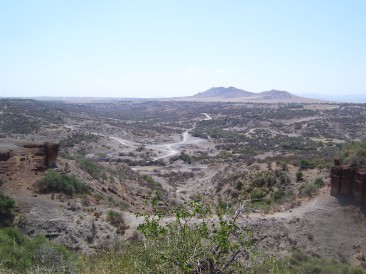
West of the volcanic slopes of Ngorongoro Crater, which was covered in another post not long ago, there is a deep cut across the landscape that interrupts the wide Serengeti Plains in northern Tanzania. A dry, winding ravine exposes layers of lava and ash, and within them, the traces of early human evolution. Named for a European misunderstanding of the Maasai word for wild sisal flowers, oldupai, Olduvai Gorge has a rich history of paleoanthropological finds, grueling excavations, and intriguing characters. Continue reading
At the Edge of the Black Lagoon

Earlier this summer, I visited the trails at Sapsucker Woods, a place of ponds filled with lilies and singing bull frogs, and boardwalks over fern-filled swamps where the mirror-smooth water resulted in a vision of a sepia-toned underworld just beneath your feet. The watery landscape was entrancing in a way that is very different from walking the hills or the lakeshore, and I found myself thinking about the singular ways that wetlands resonate in human consciousness. There is a special in-between quality to wetlands, a porous boundary with no clear shore that lingers in the imagination. Marshes and swamps and fens, like mountainsides and moors, are wildernesses that belong to monsters and outcasts, or to the dead. In Beowulf, Grendel and his mother haunt the “awful fenpaths, where the upland torrents plunge downward under the dark crags, the flood underground.” From Old English to a modern day example, there’s Tolkien, an eternal Beowulf fanboy, and his Dead Marshes with their drowned warriors.

Often these depictions are meant as a warning – to fear the creature in the black lagoon. Avoid the Great Grimpen Mire, and don’t follow the will-o’-the’whisp, the light that pixies and púcas use to lead travelers off the path to drown. Just from Saturday morning cartoons alone, we probably all thought quicksand was going to be a bigger deal in life than it ended up being. No matter what the setting, human beings tend to create stories about their physical landscapes. The special place of dread and possibility that wetlands hold in the imagination, though, doesn’t disappear with scrutiny. The archaeological stories held within wetlands are as intriguing as any myth. Maybe more so, because they are often sparse on all but the most gruesome of details.
 quakeandquiver.com